Strategic picture
When the Soviet economy cracked in the early nineties, hardliners moved. Gorbachev was gone. Marshal Viktor Rybakov’s circle replaced the old political machinery with something leaner and crueller, fixed on one goal: seize Europe before the window closed. Across the Atlantic, years of staged scandal and manufactured doubt had left Western governments hesitant and reactive. When the first columns crossed the NATO borders, many capitals were still arguing about ghosts. The militaries were less surprised. In Norway, watching Murmansk, nobody pretended the north was quiet.
Soviet doctrine treats the Barents as a sanctuary for ballistic-missile submarines, a bastion to retire behind in a general war. Norwegian bases sit on the margin of that map: NATO strike aircraft launched from them can be over Murmansk in minutes, and maritime patrol works the same coastal water the fleet treats as home. Rybakov’s planners see Finnmark as ground to be taken, not as countryside: every western kilometer pushes NATO sensors and firepower farther from the fleet’s door. The NATO posture in the north was not built up on a whim; you are here to be the obstruction, and Moscow knows it.
In summer the tundra softens into a bog that pins heavy vehicles to coastal corridors, which makes them easier to find and easier to hit. Yet right now, in late March, the ground is still iron. Soviet mechanized groups can cut across country the way doctrine always dreamed, and the weather that grounds close support in the south falls on you as snow squalls and sudden loss of horizon. Instrument work stops being a skill and becomes a habit.
Moscow demanded military transit through Finnish Lapland to shorten the route west; the Finns refused and are in their own winter war again, isolated from your chain of command but drawing blood in the forests. Sweden mobilized under armed neutrality, borders locked and airspace a wall. A Flanker that shortcuts south may meet a Viggen; a NATO jet that drifts across the line meets SAMs and politics. Divert there and you live, but you do not fly home. The battle stays in the narrow Norwegian corridor.
Combat posture
You know the small-war drill. Racetracks over a quiet patch. Weapons cold until a controller tags a hut or a truck. The stack is mostly friendlies. Rotary crews learn runs where the ground barely shoots back; the sortie turns into a scored circuit with moving shapes, not a duel. Leave that behind. Here every band of altitude is disputed. No polite ceiling. No orbit that doubles as a lounge. Altitude is a gamble, not a right. NATO and the Warsaw Pact are already at full scale to the south; you are on the northern shoulder. As aircrew in Finnmark, the arithmetic is blunt: the Soviet weight means the province cannot be held forever. Cost them every kilometer. You stay outnumbered, often outranged, and you still have to bring enough aircraft home for the next wave.
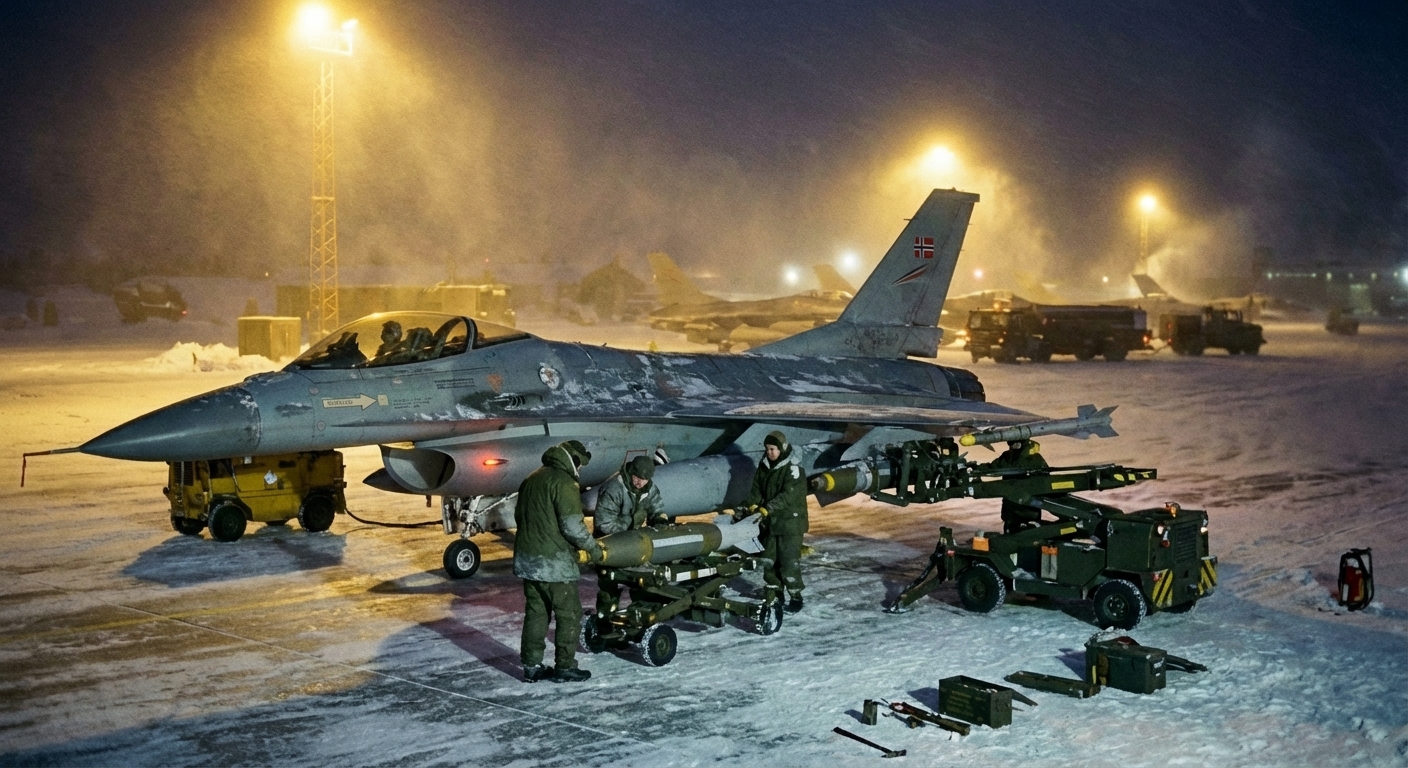
Terrain and Norwegian ground units will slow the advance, but not stop it. Early on, four launches a day is imaginable: land, refuel, re-arm, go again. Later the pace eases to one or two, in aircraft that show every hour of it. Mid-March gives perhaps eleven hours of usable light; twilight stretches the window, but not forever. Eventually the sun sets, the field phone rings, and you strap in without seeing the runway until the anti-collision flash paints the snow.
Bodø remains the formal home, but Banak, dangerously close to the spearhead, is where jets turn around until the line buckles. Rotary crew came north on exercise weeks before the war; they are folded into the same tasking now. The hardware is capable for 1996, but not miraculous: air-to-ground still means weather, mud, and iron bombs more often than it means standing off in clear sky. In the fjords, radar and missiles matter as much as courage.
The first operational problem is blunt: slow the vanguard on E6, support the fight at Tana Bru long enough for engineers to kill the bridge, and rob the enemy of momentum before the army can set its first real line. Politicians may have slept; the wing did not. What follows is paperwork, fuel, and the kind of morning that does not forgive hesitation.